
Nature Has the Power to Heal Itself. We Just Need to Stop Taking and Start Giving Back: A Conversation with Three Experts on Regenerative Agriculture
More than twenty years ago, I was convinced that technology would give us full control over nature. That we could manage agriculture and entire ecosystems through the power of logic and science. Today I see how fundamentally wrong I was.
Agriculture is one of the areas where the limits of this belief become most visible. Soil across much of the world is losing carbon, nutrients, and its ability to retain water. The systems we built on the principle of maximum efficiency are proving remarkably fragile in the face of climatic, political, and economic shifts. And yet I have a reason for optimism. Nature is stronger than we thought. And there is a way to support it. The path doesn’t lead through absolute control, but through cooperation and a willingness to give back what we have been taking for over thousands of years.
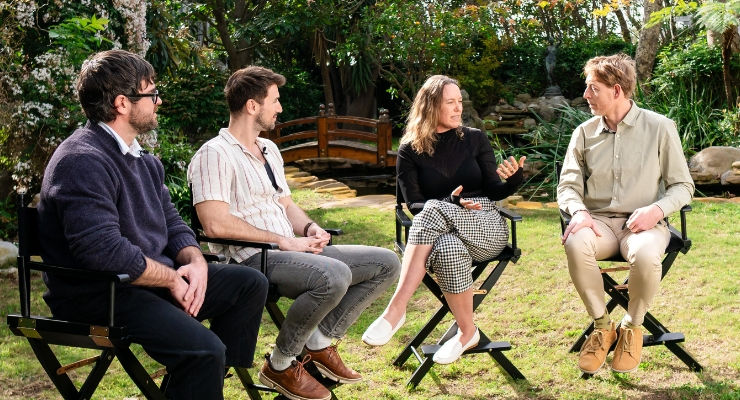
For the fourth episode of the second season of Talks 21, I invited three experts who approach this topic from different perspectives.
Henry Gordon-Smith is the founder and CEO of Agritecture, a global consulting firm focused on climate-smart agriculture, controlled-environment agriculture, and food systems planning. He has led over 350 projects across more than 45 countries, advising governments and investors. He also teaches climate-smart agriculture at Columbia University in New York, one of the most prestigious private universities in the United States.
Andrew Carter has spent over 20 years working in controlled environments and indoor farming. As the founder of Smallhold, he built one of the largest specialty mushroom operations in the US. Today, he works with some of the world's biggest players in mushroom production.
Calla Rose Ostrander focuses on climate change and regenerative agriculture. She is a founding partner of Terra Regenerative Capital, an impact investment fund that finances the transition to regenerative agriculture and opens market access for small-scale farmers.
We talked about why technology and nature don’t have to stand in opposition. About cities as a surprisingly important part of the future of agriculture. About mushrooms, from which we can learn a lot about resilience. And about carbon, which according to the latest findings may, under certain conditions, return to the soil much faster than previously assumed. In as little as six months.
You can listen to the full fourth episode of the second season of the Talks 21 podcast on Spotify, Apple Podcasts, YouTube, or directly on my website.
Key Takeaways from the Episode
True resilience emerges from cooperation with natural cycles, not from trying to control them.
According to my guests, regenerative agriculture combines traditional knowledge with modern technologies.
Since 1950, the use of synthetic nitrogen has increased twenty-threefold. According to Calla, a system based on chemical control is, by its very nature, a dependency that will eventually spiral out of control.
Urban food production, such as vertical farming, significantly increases our resilience to supply chain disruptions, as shown by both world wars and the COVID pandemic, according to Henry.
According to Calla Rose, every time we buy food, we are voting for how our landscape will be treated. And a shift through the shopping basket is, in her view, the simplest thing any of us can do.
Admitting that we don’t know everything isn’t a weakness, but a prerequisite for truly listening to nature.
How Soil Restoration Can Contribute to Greater Climate Balance
When we talk about climate change, most of the debate focuses on reducing emissions. Far less attention goes to the other side of the equation. And yet, according to Calla Rose, that is precisely where one of the most hopeful findings of modern science lies. There is currently an excessive concentration of carbon dioxide in the atmosphere. Healthy soil, however, represents one of the systems through which a part of this carbon can be gradually reabsorbed. Not only by plants, but through the wider activity of soil organisms and natural processes.
Two decades ago, the assumption was that transferring carbon from the atmosphere into a stable form in soil took roughly a hundred years. Current research shows that under specific conditions, an increase in soil carbon can be measurable within as little as six months. For me, this represents a small revolution in how we can view the climate crisis.
How is this possible? The key is photosynthesis – a process we all remember from school. Plants absorb carbon dioxide from the air and water from the soil, and using sunlight they convert them into sugar and oxygen. The sugar then serves as the primary building block and energy source for growth.
Calla Rose describes it simply: agriculture is the largest domain of human activity through which we influence photosynthesis. Every day, we decide whether carbon returns to the soil or is released back into the atmosphere through tilling.
What I found most striking in Calla Rose’s perspective is something else. In our culture, there is a recurring narrative that humans are bad for the planet. That the only thing we can do is take less, consume less, live less. Calla Rose sees it differently.
Regenerative agriculture, in her view, shows that we can be beneficial to the Earth. Through how we grow, compost, and cultivate the soil, we participate in the natural cycle of carbon, water, and nutrients. We give back what we have taken. And that, to me, represents a fundamental shift in perspective. I also explored how closely our diet connects not only to the landscape around us but to our own health and well-being in the previous episode of Talks 21, with Darin Olien.

Why Cities May Be Part of the Future of Agriculture
When we say agriculture, most people picture fields, tractors, and the countryside. Henry Gordon-Smith sees it differently. According to him, cities are a key part of the future of food production.
Henry grew up in big cities. He isn’t a farmer in the traditional sense. And precisely because of that, he looks at the entire system from a different angle. According to Henry, our society has gradually removed agriculture from cities. Yet historically, people didn’t build cities where there was no food. Farms and cities have always belonged together. But today it feels as if we have forgotten this.
The consequences are visible. Henry gives the example of Sydney in Australia. Just two decades ago, roughly 30% of the food consumed in the city came from local sources. Today, it is approximately 9%. Developers have no incentive to protect agricultural land; farmers have no incentive to stay on it. The city becomes dependent on imports, and soil is gradually replaced by concrete.
Henry isn’t saying we should grow everything in cities. He is talking about resilience – about the ability of cities to produce at least part of their own food in times of crisis. History shows that this isn’t utopian. During both world wars, so-called victory gardens played a significant role in food supply. During COVID, many communities spontaneously returned to growing their own food. According to Henry, the future will require us to systematically rebuild this capacity.
It isn’t a choice between high-tech and low-tech. A vertical farm can stand alongside a community garden. A greenhouse on the edge of a neighbourhood next to a school garden. What matters is to stop seeing cities and nature as two separate worlds and start connecting them.

What We Can Learn from Mushrooms for the Future of Agriculture
Mushrooms form their own kingdom, and according to Andrew Carter, they are in some respects closer to animals than to plants. Their fundamental role lies in the decomposition of organic matter. They take what we consider waste – compost, sawdust from the timber industry, remnants that would otherwise end up in a landfill – and break it down into nutrients that return to the soil.
Andrew describes how large commercial mushroom farms essentially function as massive composting systems. Mushrooms grow from compost, and what remains after harvesting is returned to fields as fertilizer. This reveals an interesting principle: organic matter we often no longer know how to use can still become valuable food.
And then there is a detail that, according to Andrew, most people are unaware of. A large share of commercial mushroom production in the US is effectively organic. Pesticides and other chemicals are barely used in mushroom cultivation. Yet shops still want both conventional and organic labels, so farmers often sell essentially the same product under two categories. Mushrooms simply don’t need pesticides the way other crops do. This makes them an increasingly relevant part of the future food system.
According to Andrew, this is the very principle that modern agriculture often lacks. A system where nothing goes to waste. Where the by-product of one process becomes the input of another. Mushrooms do this naturally. The question is how we can extend this logic into other parts of human production, so that we take no more from the landscape than we give back?
Listen to Episode 4 of Season 2 of Talks 21
In the full conversation, we covered much more. How Henry helps governments and investors in more than 45 countries design agriculture resilient to climate change. Why Andrew believes evolution isn’t keeping up with the speed of climate change, and what that means for how we grow food. Or why Calla Rose says that with every purchase at the store, we are voting for how our landscape will be treated.
You can listen to the full conversation on Spotify, Apple Podcasts, YouTube, or directly on my website.


Comments