
Are We Looking for Happiness in the Right Place? Darin Olien on What Weakens Us and How to Reclaim Our Inner Strength
We live in an age of extraordinary comfort. Food is within arm's reach, technology answers before we finish asking, and modern life offers a level of convenience previous generations could hardly have imagined. And yet so many people today feel exhausted, distracted, and somehow hollow inside. So are we, in fact, looking for happiness in the right place?
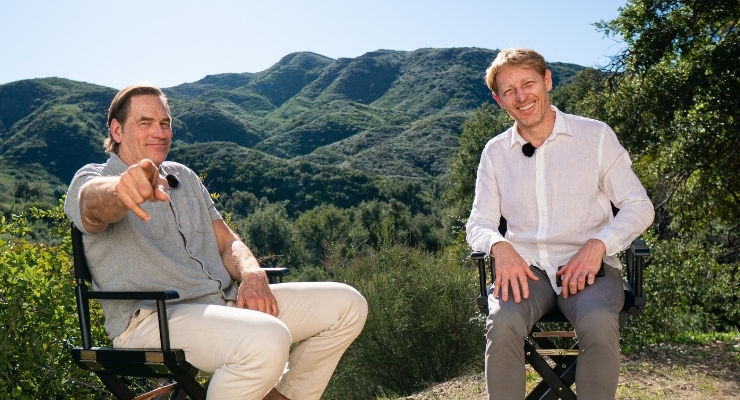
For the third episode of the second season of Talks 21, I invited Darin Olien – author of the books SuperLife and Fatal Conveniences, co-creator of the documentary series Down to Earth with Zac Efron, and producer of a new documentary project, A Road Map To Happiness, launching this year. Darin is a systems thinker who sees the connections between what we eat, how we live, and how the hidden temptations of modern life shape us. For the past twenty years, he has been exploring which everyday habits and conditions genuinely support human health and well-being.
Across our conversation, we explored what, according to Darin, truly makes a person happy – and why it has far less to do with money, success, or comfort than it might seem. Why the very things meant to be rewards for our work begin, at a certain point, to weaken us. And also why he believes our happiness is in our own hands – not a matter of chance, but the result of everyday decisions.
You can listen to the full third episode of season two of the Talks 21 podcast on Spotify, Apple Podcasts, YouTube, or here on my website.
What to take from this episode
According to Darin, happiness is the sum of small everyday habits.
Harvard research shows that the quality of our relationships and the community we live in matter more for a long, fulfilling life than diet, supplements, or exercise.
According to Czech neurologist Prof. Martin Jan Stránský, M.D., dependence on social media affects the brain in ways comparable to heroin addiction.
The comforts of the modern world can, at a certain point, turn against us and begin to weaken us.
Pain, risk, and stepping out of the comfort zone are part of a healthy life.
Real change begins the moment we stop waiting for someone else to make it happen.
According to Darin, one of the core pillars of happiness is the feeling that what we do has meaning.
Where to look for real happiness
We opened our conversation with a simple question: what actually is happiness, and how do we reach it? Darin sees happiness not as a state of constant euphoria. He describes it as a steady inner ground – something closer to balance than to elation. It isn't something that happens to us by chance one day. It's the sum of small everyday habits and conscious choices. To a significant degree, Darin says, our happiness is in our own hands.
In this context, we also discussed money. From my own experience, money plays its part in the equation – but only up to a point. Even an abundance of resources is no guarantee of contentment. If a person isn't at peace within themselves, not even a lottery win will bring them happiness. Greater resources bring greater responsibility, and for someone without that inner stability, they can become more of a burden than a blessing.
So, according to Darin, what should we focus on? Across the many cultures Darin and his team are visiting for the new documentary, contented people seem to share several common elements. Yet one of them stands out above all the rest. What exactly that is, you can discover by listening to our full conversation.
Why comfort weakens us
When I asked Darin what he believes is behind the apathy of today’s Western society, he shared a perspective that he also explores in his book Fatal Conveniences. The comforts we have built over generations as a reward for our work seem to have reached a turning point. Instead of setting us free, they have, as Darin puts it, begun to weaken us.
I observe that we have everything within arm's reach, yet we are gradually losing the ability to step out of our comfort zone, to face risk, or to speak up when it matters. An interesting parallel can be found in the mouse experiment I mentioned in our conversation. When we create a paradise for mice – full of food, safety, and no threats – within two years the entire colony falls apart. In absolute abundance, a generation arises that loses interest in reproduction, in protecting the weaker ones, in any kind of social bonds at all. These mice become completely apathetic, isolate themselves from others, and do nothing all day but obsessively groom themselves and clean their fur. Outwardly, they appear healthy, but inwardly, they are socially empty – and this leads to the gradual extinction of the entire population.
In a certain sense, I think something similar may be happening to us as human beings. Many indigenous cultures understood this well. Native American tribes, for example, had rites of passage in which young men had to endure pain and face their fears to truly come of age. I spoke about the power of these rituals – and how much we miss them in modern society today – in one of the earlier episodes of Talks 21, with my wife Lilia Khousnoutdinova.
This phenomenon also has a deep biological dimension. As I mentioned in the episode, according to Czech neurologist Prof. Martin Jan Stránský, M.D., dependence on social media affects the human brain in ways comparable to heroin addiction. The conveniences of modern life thus encroach not only on our comfort but directly on our decision-making processes and our freedom of judgment. And yet a way out does exist – and it often begins with the simplest things. A return to nature. A deep conversation with someone close instead of another evening in front of a screen. Movement that pulls us out of comfort. I love climbing barefoot over rocks with my children. Movement is essential.
Pain, crisis, and the growth that comes from them
With Darin, we touched on a theme I keep returning to in Talks 21 – pain and crisis as part of a healthy life. In my conversation with Daniel Pinchbeck, we spoke about initiation and its absence in modern society. With Uria Tsur, we explored working with the voice as a path to deeper self-knowledge. And now with Darin, we returned to the question of why comfort alone does not move us forward.
On this we agree. Without encountering pain, it is hard to truly appreciate what we have. Life has shown me many times that we sometimes need to experience the negative in order to recognise the positive. Sometimes a mere hint is enough – a brief glimpse of something difficult – and we begin to see things differently.
When did you last experience a moment that turned your view of the world around?

Listen to episode 3 of season 2 of Talks 21
Our conversation with Darin opened up many other important themes as well. We shared what happened during the nine months following my serious skiing accident in 1999. Darin spoke about meeting the grandmother of former U.S. President Barack Obama under a mango tree in Kenya, and about a project that brought clean water to 500,000 children. We also discussed the countries and cultures he and his team are visiting for a new documentary series, as well as the community they are building around it. You can find out more about the project at roadtohappy.net.
You can listen to the full conversation on Spotify, Apple Podcasts, YouTube, or here on my website.


Comments