
Why the Hardest Moment of His Life Became a Gift: Ross McKenzie on His Journey Through a Bipolar Diagnosis
Many of us have learned to treat a difficult state of mind as something to quiet and push aside as quickly as possible. And often there is a good reason for that. Sometimes a symptom needs to be stabilised before anything else can happen. But what if those same symptoms are also pointing to something deeper? What if, underneath them, there is a story waiting to be understood?
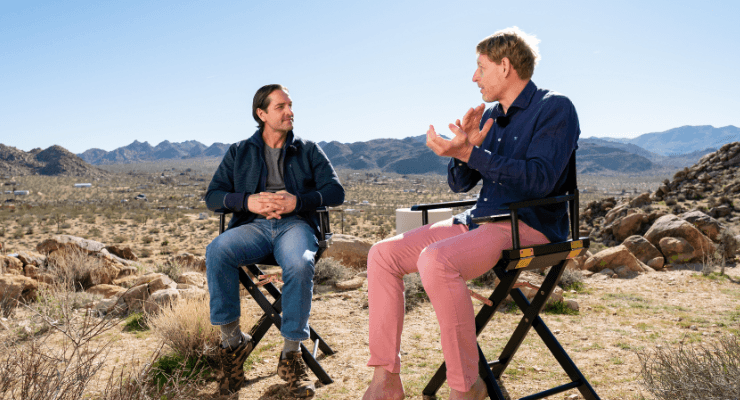
For the fifth episode of the second season of Talks 21, I invited Ross McKenzie, a Canadian filmmaker and the co-creator of the documentary Bipolarized. More than thirty years ago, at the age of twenty-one, Ross went through what he describes as a spiritual emergency. It led to hospitalisation, a bipolar diagnosis, and eighteen years of lithium treatment. Rather than seeing it as the end of the story, he set out on what became a twenty-year search to understand what had actually happened to him. That search eventually led to this film. Today, he works as a life coach, helping others look beyond their symptoms to understand their root causes.
Across our conversation, we explored Ross’s remarkable story. We talked about what Ross describes as becoming “the CEO of your own healthcare”, and why such a path requires patience, support, and guidance from people with real expertise. We also discussed the role of medication – its value in stabilising extreme states, but also its limits when used as the only framework for understanding healing. And we spoke about resilience, and why the hardest moments in life may carry more meaning than we initially recognise.
You can listen to the full fifth episode of the second season of the Talks 21 podcast on Spotify, Apple Podcasts, YouTube, or here on my website.
What to Take from This Episode
According to Ross, the most empowering question we can ask is not what is wrong with us, but what our symptoms might be trying to teach us.
Medication has its place. Ross is clear that it can be essential in extreme states, but on its own, it often does not address root causes.
Coming off medication is something Ross believes should be done gradually and safely, in collaboration with doctors who understand the process.
Ross also emphasises how difficult it is to move through such a process in an environment shaped by fear, which is why supportive relationships and community matter so much.
Good sleep, nutrition, and movement, along with a simple daily prayer, are the everyday basics Ross relies on to stay grounded.
Difficult experiences, faced rather than avoided, can build resilience and inner strength instead of only leaving scars.
Treating the Cause, Not Just the Symptom
When something in our mind or body starts to feel unbalanced, our first instinct is usually to ask, "What is wrong with me?" Over time, I have learned to turn that question around in my life. When something difficult happens, I try to step back, become more of an observer, and ask what it might be trying to teach me.
So I felt a real sense of kinship when Ross described the very same shift as a turning point in his healing. He stopped asking “what is wrong with me” and started asking “what are these symptoms here to teach me”. And that shift changed his relationship to his diagnosis. It was no longer something that defined him, but something he could begin to work with.
What stands out in Ross’s perspective is that it is not a rejection of medication. He is clear that it has its place and can bring real relief in extreme states, and that coming off it should always be done carefully, with medical support. What he questions is the idea that medication alone is the full answer, rather than one part of a longer process of understanding what lies beneath symptoms. It is a perspective that echoes an earlier conversation with Rick Doblin, in which we explored healing trauma at its root rather than merely numbing its expression. Just how far Ross took that search for himself, and where it ultimately led him, is something I would rather you hear from him directly.

Why the Hardest Moments Can Become Our Greatest Teachers
A life without pain is not something we should aim for. Without the difficult moments, we would hardly be able to recognise the good ones. What I try to do instead is work with difficult experiences in a way that reduces their weight, so that space opens up for the more positive ones. So it was a pleasure to find out that Ross sees it in a similar way. He spoke about staying grounded through both highs and lows, observing thoughts without attaching to them, and recognising, as he put it, that we are not our thoughts.
What struck me most is that Ross does not only accept difficulty – he sometimes seeks it intentionally. He described deliberately doing hard things, and how, like a muscle, our capacity to meet challenges grows through practice. This idea runs through the entire season of Talks 21. In our conversation with Darin Olien, we explored how the comforts of modern life can quietly weaken us, and with Daniel Pinchbeck, we spoke about pressure and crisis as engines of change. Ross brings this idea back into a very personal space. The more we are willing to meet difficulty directly, he suggests, the more steadily we are able to face whatever life brings next.
Why We Should Face Our Own Shadows
According to Ross, the most important work any of us can do right now is what he calls shadow work: the willingness to face the parts of ourselves we would rather avoid, instead of letting them quietly shape our behaviour from behind the scenes. He is honest that when we avoid them, we often reach for something else to numb the discomfort. He spoke openly about his own version of this, an addiction not to a substance but to consuming the news, a constant stream of negative content through the device in his hand. When he finally stepped away from it, he noticed how quickly he began to feel calmer. It reminded me of something Darin Olien and I discussed about how a dependence on social media can affect the brain in ways comparable to far harder addictions, a parallel explored in our conversation about happiness.
Doing this inner work also requires a certain level of trust, and this is where Ross and I found common ground. Many years ago, I was a skeptic who believed we were here by pure chance. Today, I am certain we live in a magical universe, where what happens is not random. When we find the courage to do the uncomfortable thing with good intentions, the universe tends to meet us halfway. Ross felt this in his own life, too, as the right people kept appearing once he started asking the right questions. For me, this is not a leap away from reason, but an expansion of it. The same move from a narrow rationality toward an expanded one that I explored in my lecture The Art in Mathematics – Divine Signature in Numbers.

Listen to Episode 5 of Season 2 of Talks 21
What does it feel like to go through a near-death experience while strapped into a straitjacket, and to carry that moment with you as an anchor for years afterwards? Ross shared that story with remarkable openness. He also spoke about the firewalk seminar in Chicago, which led him to what he describes as a spiritual emergency, and about the time in Costa Rica, where he eventually stopped taking lithium.
There was far more than this article could hold, including the relationships he had to let go of, and the message Ross now wants to pass on to a younger generation.
You can find the documentary Bipolarized and Ross's work at rossmckenzie.com, and listen to our full conversation on Spotify, Apple Podcasts, YouTube, or here on my website.


Comments